September 19, 2023
Marking 50 Years of Life With a Spinal Cord Injury
Doug Shull has seen a lifetime of change in the 50 years he has lived with a spinal cord injury (SCI). Injured in a shallow water diving accident at 16 years old, Doug has lived more of his life with an SCI than without, and he’s seen the past five decades bring change and advancements in technology and accessibility as well as in cultural attitudes toward people with disabilities.
In July of 1973, Doug was spending the day with friends at a lake near his hometown of Morton, Illinois. A competitive swimmer for most of his childhood, he was accustomed to shallow water dives and dove into the water as he had done many times before. But that day, he unexpectedly hit something in the lake and sustained a C3/4 spinal cord injury. After he was pulled from the lake and resuscitated by his friends, the teens ran for help and quickly found a paramedic driving through the area in an encounter Doug still marvels at today.
“Do you have any idea what the odds are there was a paramedic driving in a remote area back in 1973? I think he was more like an angel,” Doug says.
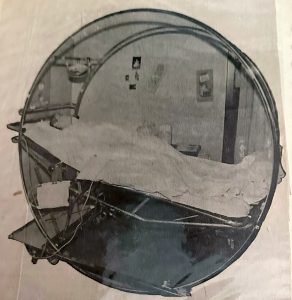
The paramedic was able to help stabilize Doug and get him to a local hospital. From there, he was transferred to a larger trauma hospital where he was given a 1 percent chance of making it through the next 24 hours. Despite these odds, he survived and spent the next five months in rehabilitation at the Illinois hospital, only receiving two hours of therapy a day. But thanks to Doug’s grandfather and a local Craig grad’s family member who frequently visited him, Doug learned about Craig Hospital and was able to transfer to Denver for the remainder of his SCI neurorehabilitation.
“My grandpa paid for the air ambulance. For me to come to Craig, I considered it to be a real blessing and a great opportunity,” Doug says. “As an athlete, I took my athletic training that I had from running and swimming, I used that same attitude to train. Instead of training for a race, I was more or less training for life with a spinal cord injury.”
Doug spent three months at Craig and still recalls the early mornings, his firm but encouraging care team, and the deep peer connections he made with fellow patients.
When Doug returned to Illinois after his rehabilitation, he set five goals for himself:
- Graduate from high school with his class
- Graduate from college
- Find a job
- Drive again
- Marry and start a family
But Doug’s return to his hometown in a time before the Americans with Disabilities Act didn’t come without barriers to his goals.
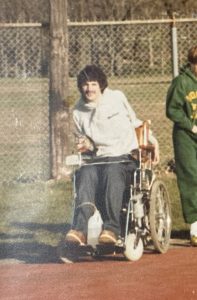
His high school was not wheelchair accessible, and the school’s administration encouraged Doug to stay home to finish out his schooling. But he and his mother, a schoolteacher herself, fought to have him return to his school, and the school eventually installed ramps. Doug even recalls how the ramps ended up benefitting the school’s staff, and they became permanent fixtures at the school even after he graduated. During his senior year, he was voted student mayor for the day and was able to advocate for the town’s first curb cutouts to be installed on Main Street.
A few years later, Doug accomplished his first goal and graduated with his high school class, going on to attend the University of Illinois for a degree in finance. He graduated in 1979 into a harsh job market and returned to school to become a teacher, volunteering as a coach for the girls’ track team and the boys’ long-distance running team. But in the middle of his student teaching, Doug was offered a job at the local bank in Morton and began his 29-year finance career.
With three of his goals now accomplished, he looked into returning to driving but found that he didn’t have the arm function necessary to use the adaptive tools that were available at the time. Then in 1993, a new technology was introduced that allowed him to achieve his fourth goal.
“Technology is the biggest change I’ve seen. I always had to depend on someone to take me to doctor’s appointments or work. It was a big accomplishment to be able to drive again,” Doug says.
And then two years later, Doug met Angie. They connected at a church dance in March of 1995 and hit it off immediately. In July of the same year, Doug proposed to Angie at the fateful lake where he sustained his SCI as a teen.
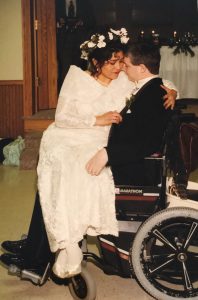
Angie recalls from their time at the lake that day: “He said to me, ‘Twenty-two years ago, something happened here to me. But 22 years later, God brought you into my life. Would you be my wife?’” This December, Doug and Angie will celebrate their 28th wedding anniversary and have a son, daughter-in-law and three grandchildren.
And now in 2023, they are marking another anniversary: the 50th anniversary of Doug’s injury. Each year, Doug and Angie return to Craig for his annual Interdisciplinary Outpatient Evaluation (IOE), and this year, Angie and his care team put together a special surprise for Doug. Members of his care teams, past and present, gathered to throw an anniversary party to celebrate him and share memories.
“It was an honor to share this milestone with Doug and Angie. They exemplify the Craig spirit of resilience and perseverance,” says Kathy Hulse, a Craig Hospital clinical care manager who has known Doug for more than 30 years. “They continue to teach us how to live with injury so we, the staff, can teach others.”
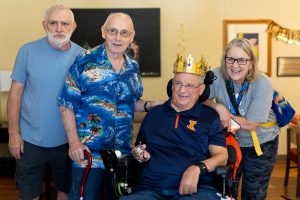
Doug adds: “I have developed some great friendships with some of the nursing staff and therapists. I look forward to seeing them every year. Living with a spinal cord injury for 50 years was a team effort, and I wanted to acknowledge all of those who helped me reach this milestone. Without my Lord providing the staff at Craig and all my caregivers, there is no way a high-level quad like myself could’ve survived. I consider Craig one of the key members of my team. It was an honor for my friends of Craig to celebrate with me.”
With 50 years of life experience with an SCI, Doug says that some of the biggest changes he has seen over the years are around the cultural attitudes and legal protections for individuals with disabilities.
“I think the awareness of disabilities and not having to constantly advocate has improved,” Doug says. “We live longer now. We’re not just institutionalized; we’re out in the community, and we’re not so isolated. That’s made a big difference.”
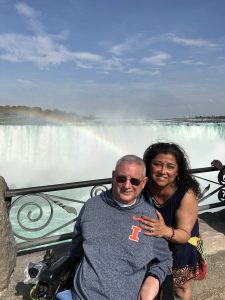
Living with an SCI is not without its challenges. Doug shares that some of the most difficult things he’s experienced over his lifetime with an SCI are long-term health issues and the costs associated with them: “It can be discouraging, the amount of out-of-pocket expenses you have for daily living. I’m spending quite a bit of money on a daily basis to just get up for the day and go to bed.”
Even through the obstacles Doug has overcome, his life has been filled with moments of resilience, joy and connection. His proudest accomplishments from the past five decades include being able to complete his five goals, coaching track and cross country, serving at his church, participating in the Los Angeles Marathon twice with a high school friend, traveling, dancing with his wife, and spending time with his family and grandchildren.
Doug’s biggest advice for others: “Rejoice in the things you can do and get to do, and don’t dwell on the things you cannot do. Find your new normal. Trust God and lean on Him. The wheelchair and other devices are just tools; the individual in the chair is the same person.”
Keep reading
October 7, 2026
A Second Chance at Life
September 22, 2026
A Legacy of Giving: Steve Baker’s Positive Impact on Craig Hospital
September 8, 2026
A Long Ride Back: Grit, Gratitude and Craig Hospital