October 7, 2026
A Second Chance at Life
Before Elizabeth Bock was thrown from her horse in July 2022, she had no idea how common traumatic brain injuries (TBIs) were in this country.
“Every year, about 3 million people in the U.S. sustain a TBI, which is one injury every nine seconds,” Elizabeth says. “That means there’s a 70 percent chance each of us will experience a TBI in our lifetime.”
She adds, “When I awoke from my 36-day coma, I didn’t know what a TBI was. I also didn’t remember who I was. I rebuilt myself after relearning everything, including how to use a fork and how to walk. This is my second chance at life.”
A Catastrophic Jump
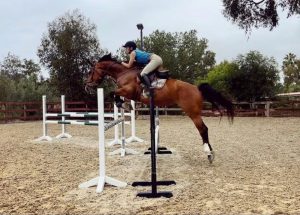
While Elizabeth, who was 42 years old at the time, has no memory of July 13, 2022—or the weeks prior to that day—she’s been told that she was taking a riding lesson at her horse stable in Malibu, California.
“As an avid rider since I was 7, I was practicing a jump when my horse fell into the jump with me on her back. To get up, she stepped on top of me,” she says. “When my head hit the ground, my neurons sheared from the rotational impact, my eyes rolled back, and I stopped breathing. The medical report read ‘blunt force trauma,’ but my helmet did not have a single scratch.”
Elizabeth was immediately airlifted to the closest trauma hospital in Los Angeles, where she remained in a coma for the next month before transferring to Craig Hospital for brain injury neurorehabilitation: “My brother flew with me to Denver, where I remained in a coma for the first week. As I slowly began to wake up, I vaguely recall the stages of my recovery. It’s similar to remembering childhood—piecemeal and patchy.”
While at Craig, Elizabeth participated in physical, speech and occupational therapy, as well as recreational therapy. “Group painting classes, flower arranging, and outings to a local Pilates studio made me feel happy and more like myself,” she recalls.
Elizabeth adds, “Painting, ceramics and writing were definitely instrumental in my recovery and aided me in becoming whole again. I found art to be a needed form of expression when my mind, ability to speak, and vision were changed. Art is a wonderful tool for knowing who we are and what we are capable of.”
Continuous Challenges
Today, Elizabeth still wrestles with her invisible injury. “I don’t know what I don’t know, but I am keenly aware that I don’t remember all of what I used to know,” she says. “I think of my memory as a slice of Swiss cheese—there are numerous holes. I don’t know how large or small the holes are … I just know there are holes.”
In addition, Elizabeth struggles with double vision: “My eyes work independently, producing two images with one on top of the other and slightly askew. I think of it as a ghost image. I wear an eye patch to drive.”
Noise is also a constant challenge for Elizabeth. “I need to remove myself from the many sensory overloaded situations that I now experience, and I carry ear plugs with me everywhere,” she explains. “Additionally, my brain doesn’t multitask. I can’t do two things at once, the way I used to. To maintain a sense of calm, I now focus on one thing at a time.”
As a former valedictorian and hedge fund executive, Elizabeth maintains that being forced to end her professional career was difficult for her, but she has learned to accept and embrace it.
“The brain does not return exactly to the way it was before an injury. Instead, we are different post-TBI,” she says. “As a survivor, this is not easy to accept, but I focus on the fact that I have a wonderful life. I have a brain injury, not a mindset injury. Before my accident, I was a workaholic. I used to think being smart and making money was important and defined who I was. But I do not believe that anymore. My accident awakened my true self, and I don’t compare myself to who I used to be. I am so much bigger, so much more.”
Raising Awareness
Doctors have called Elizabeth a “medical miracle,” someone who was able to beat the odds.
“Now, knowing what a miracle it is to be alive, I am inspired to spread the word about brain injuries,” she says. “TBI recovery is not like placing a cast on a broken bone. Nobody can tell you when or how much you will recover. The key is maintaining hope. Faith is the difference between a good or bad recovery. Many of us can go on to live fulfilling lives—we just need help. And that starts with more awareness and research towards better treatments. This is an invisible injury that needs to be visibly supported to affect change.”
She adds, “Craig is a world-renowned neurorehabilitation and research hospital that is helping to affect this needed change. Being at Craig made me feel safe and cared for. I knew I was in expert hands. I was surrounded by people who knew what they were doing, and I felt like I was going to be okay. I now support the Craig Foundation because it’s an important way for me to give back and to say thank you.”
To learn more or donate to help Craig grads like Liz, please visit craighospital.org/foundation/donate.
Keep reading
September 22, 2026
A Legacy of Giving: Steve Baker’s Positive Impact on Craig Hospital
September 8, 2026
A Long Ride Back: Grit, Gratitude and Craig Hospital
August 28, 2026
Miles and Milestones: Ben Edwards Navigates His College Journey