August 14, 2026
From Service to Support: Collaborative Care for Craig’s Military Patients
Originally created as a program to address the high rates of traumatic brain injury (TBI) among post-9/11 veterans returning to Colorado, Operation TBI Freedom (OTF) became a Craig Hospital program in 2016. Today, OTF provides active duty personnel and veterans with free, long-term, non-clinical case management, as well as benefit navigation, crisis support and emergency financial assistance.
“When a military patient is admitted to Craig with a brain or spinal cord injury, we work very closely with the Clinical Care Management (CCM) team to collaborate on how best to navigate the military system,” explains Mark “Mik” Spillane, an OTF program eligibility specialist. “Working with the military can sometimes feel like you’re speaking a foreign language, so OTF bridges the gap when it comes to coordinating patient services and benefits for military patients.”
Craig CCM Carolynn “CJ” Barashkoff adds, “In the case of Larry Xiong — an active duty, senior airman stationed at Buckley Air Force Base and a Craig patient — Mik and I worked closely with Larry and his family to ensure the hospital provided the best individualized care via an interdisciplinary team approach. Our goal was to make sure Larry received comprehensive services to improve his quality of life, while also achieving independence.”
Navigating a TBI
Born in Fresno, California, Larry grew up in a close-knit family with five siblings. He struggled to figure out his career path before joining the Air Force at age 20.
“Because we are not a military family, we were initially uncomfortable with Larry’s decision to join the armed forces,” his older sister, Mor Xiong, explains. “But Larry was very content in the military and continued to re-enlist. As we watched him thrive in his position, we all came to accept his career choice and were happy for him — until his accident.”
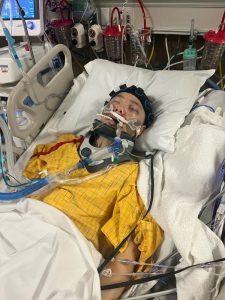
In December 2025, Larry was riding his motorcycle near his home in Aurora, Colorado, when the 30-year-old collided with a car. He sustained a severe TBI and a broken leg. After spending time in the ICU at a local hospital, he was transferred to a long-term care facility before arriving at Craig in early February 2026.
“The Air Force originally wanted Larry to do his rehab at a military hospital in another state, but we asked to stay in Colorado,” Mor says. “At the time, our family was in Colorado to be near Larry, so going to Craig made the most sense. And thanks to [donor-supported] Family Housing, we could all be near my brother to support him through his rehab journey.”
She adds, “It was a relief to get to Craig. The staff were extremely knowledgeable and welcoming, and they continuously kept us in the loop on every aspect of Larry’s recovery.”
Bridging the Gap
When Larry first arrived at Craig for two months of brain injury neurorehabilitation, he was just waking up from the accident. And as soon as he was able, he took part in numerous therapies, including physical, speech, occupational and recreational therapy.
“The nice part about Larry being an active duty airman was that we never felt alone,” Mor says. “It was all hands on deck at all times. Not only did the military assign us a family liaison for support, but Mik and CJ were constantly there for us — and for Larry.”
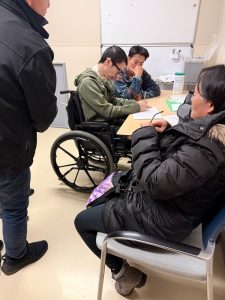 She adds, “They were on top of Larry’s rehab timeline, as well as his daily needs and what his discharge would look like. It was so helpful to have their constant support.”
When it was time for Larry’s discharge in late March, the team decided that he needed to transfer to a military rehabilitation facility in San Antonio, Texas, for several months. “We were all in attendance at his discharge meeting, including his military, OTF, and Craig teams,” Mor says. “It really was a joint effort.”
In late May, Larry returned to Craig for outpatient therapy, with his family surrounding him once again. “After he completes outpatient therapy, the Air Force will conduct an evaluation to determine whether Larry can return to active duty,” Mik explains. “If the team decides that he is unable to return, due to his injury, he will be medically retired.”
Because TBIs are often invisible injuries, the transition to civilian life can be quite challenging. As a result, OTF develops a unique life plan for each client that promotes optimal independence and productivity. OTF not only focuses on supporting veterans through their recovery and rehabilitation, but through reintegration as well.
“We feel extremely lucky to have this kind of support as we navigate Larry’s TBI,” Mor says. “It has definitely been stressful for all of us, but this type of coordinated care has made the process so much easier. And while I don’t know what comes next for my brother, I do know that we are not alone on this journey.”
OTF is a donor-supported program. To learn more or donate to help Craig patients like Larry, please visit: https://craighospital.org/foundation
Keep reading
October 7, 2026
A Second Chance at Life
September 22, 2026
A Legacy of Giving: Steve Baker’s Positive Impact on Craig Hospital
September 8, 2026
A Long Ride Back: Grit, Gratitude and Craig Hospital