June 28, 2023
Finding Freedom and Independence Once Again
First discovered in the U.S. in the summer of 1999, West Nile virus is spread when a mosquito bites an infected bird and then a human. While most people (eight out of 10) infected with West Nile virus do not experience serious symptoms, about one in 150 people develop a severe illness affecting the central nervous system.
Dryden Thompson is one of these people.
In August of 2021, 24-year-old Dryden developed symptoms similar to the stomach flu. However, within a few days, his symptoms began to get much worse. “His eyes were moving in two different directions, he was dizzy, and he was extremely confused,” explains Grace Pederson, Dryden’s longtime girlfriend. “That’s when I knew it was time to take him to the ER.”
Within days, Dryden was diagnosed with a very serious case of West Nile virus, which attacked his nervous system and neurological function, causing encephalitis and a C4 spinal cord injury.
Healing Through Therapy
 Dryden spent four months in a hospital in Fargo, North Dakota, close to his home before flying via air ambulance to Craig Hospital.
“Shortly after arriving at Craig, I developed a contagious bacterial infection in my lungs from the ventilator, so I spent my first two months in isolation,” Dryden explains.“But my care team arranged for me to do all of my therapies in my room, so my rehabilitation would not be delayed.”
Once Dryden recovered from the infection, he was able to concentrate on physical, occupational and speech therapy six hours a day, five days a week.
“In addition to learning to walk and speak again, he spent a lot of time focused on re-learning activities of daily living, including getting dressed, teeth brushing, laundry, cooking and cleaning,” Grace says. “We were impressed with the amazing job that Craig does in setting up patients for independence and success after discharge.”
On weekends, Dryden participated in recreational therapy, which included driving track chairs, hunting, shooting, video gaming and learning how to navigate the airport.
“These activities were important to Dryden because he is such an outdoorsy and active person,” Grace explains. “There is no question that he really missed spending his time outside, golfing, fishing, hunting and biking.”
Back in the Saddle
In June of 2022, following a five-month inpatient stay and one month in outpatient therapy, Dryden was able to walk out of Craig with assistance.
After spending almost a year in the hospital, Dryden and Grace were eager to get back to their lives in Minnesota. “Before I got sick, Grace and I were extremely active, always looking for the next big adventure,” Dryden says. “Summers in Minnesota are spent outdoors, but my ability to take part in these activities, such as long bike rides with my family, were limited due to my illness. I was unable to return to the activities that I used to love, and I felt trapped.”
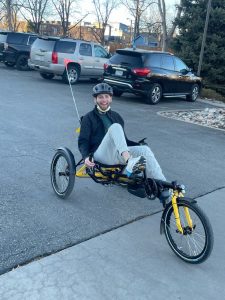
So when Laura Vogel, Dryden’s recreation therapist, suggested an assistive bike, he began to feel excited and hopeful. Dryden first test-drove a tandem bike, but he felt that it would not provide him with the independence that he craved.
Next, he experimented with a fat tire bike but decided that this type of bike was not suited for Minnesota’s terrain. The third bike—the Hase Kettwiesel with e-assist—was perfect.
Dryden says, “I fell in love with the Hase Kettwiesel because it was just right for me. The bike allows me to use the strength that I currently have in my legs, but also provides e-assist when I need a break. With this bike, I can be independent and ride on my own.”
He adds, “While cycling, I felt like part of my life came back. I remember feeling a sense of relief and freedom. It was honestly the best day since I got sick. For the first time in a year, I could actually do something without the help of others. I have not felt passionate about much since being in a wheelchair, and this is one activity that made me feel like a new person.”
With a $9,000 price tag, the bike was difficult for Dryden to afford. But a Craig donor-funded adaptive equipment scholarship enabled Dryden to purchase the adaptive bicycle, which will be shipped to Minnesota just in time for summer.
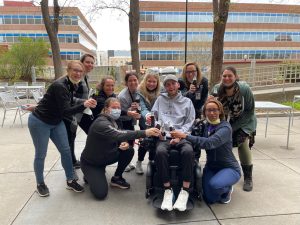
“I can’t wait to cycle again. I will be able to ride and become the adventurous soul that I once was,” Dryden says. “Not only will I have independence, but I will be able to participate in family events without feeling like I am someone I am not. I will be happy and free again.”
Grace adds, “I can’t wait for Dryden to get on that bike, so his mind and spirit will begin to heal and he realizes that life is going to be okay again.”
Keep reading
October 7, 2026
A Second Chance at Life
September 22, 2026
A Legacy of Giving: Steve Baker’s Positive Impact on Craig Hospital
September 8, 2026
A Long Ride Back: Grit, Gratitude and Craig Hospital