June 12, 2025
Intensive Aphasia Program Empowers Patients and Families
Imagine knowing exactly what you want to say, but the words just don’t come out right or even at all. That’s what life can be like for someone with aphasia, a communication disorder that can impact a person’s speaking, understanding, reading and/or writing abilities despite having no effect on their intelligence.
June marks Aphasia Awareness Month in the U.S., where roughly 2 million people are living with aphasia and more than 180,000 new cases are diagnosed each year. Many of these cases stem from traumatic brain injury and stroke.
Despite being so common, aphasia is a term that 84.5% of Americans have never heard of, according to the National Aphasia Association. Raising awareness for it is crucial for many reasons, such as reducing social isolation for individuals with aphasia, strengthening support for treatment through funding and research, and breaking down stereotypes associated with the disorder.
“Obviously, language is so important for connecting with people and expressing yourself,” says Betsy Batts, MS, CCC-SLP, CBIS, an outpatient speech-language pathologist (SLP) at Craig Hospital. “Aphasia therapy and aphasia programs are so important because they empower patients to interact with people, get back to work, and improve relationships with friends and family because they’re less afraid to engage in conversation.”
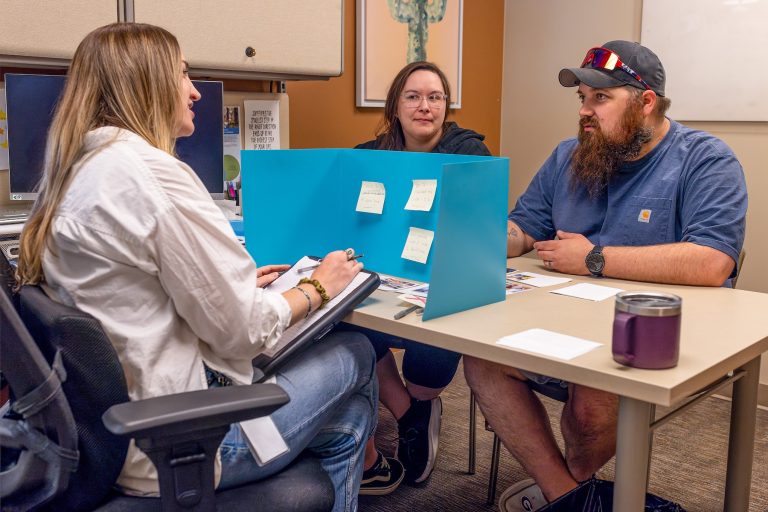 Betsy serves as the coordinator for the Craig Hospital Aphasia Therapy (CHAT) program, a three-week intensive aphasia program in which patients meet with an SLP for three to four hours each day, with remaining hours supplemented by music therapy, group therapy, embodied practices and augmentative alternative communication (AAC).
The program is highly individualized and has treated 87 unique patients across 113 treatment series since its inception in 2017.
“That’s the benefit of one-on-one therapy,” says Betsy, who started working at Craig in 2021 as an SLP on the inpatient side. “We do a full assessment when patients first arrive to figure out exactly what their strengths are and what their areas for improvement are. We tailor the program to whatever it is they need.
“Maybe the patient is having difficulty with word finding, like nouns over verbs,” Betsy continues. “Maybe they’re not using prepositions and that’s impacting how people are able to understand them. Maybe it’s needing more grammatical structure to make fuller sentences or something as simple as practicing family members’ names. Every program is entirely different.”
The CHAT program is designed to support both patients and their loved ones, who learn strategies together for promoting positive communication outcomes. Family members are strongly encouraged to be present for the entire program.
“We do a lot of family training and provide education on specific types of aphasia,” Betsy says. “Sometimes people don’t even realize how aphasia impacts them and to what degree. They leave the program with a much better understanding and more confidence that they know how to deal with it.”
To learn more about CHAT, please visit the CHAT page at the Craig Hospital website.
Keep reading
October 7, 2026
A Second Chance at Life
September 22, 2026
A Legacy of Giving: Steve Baker’s Positive Impact on Craig Hospital
September 8, 2026
A Long Ride Back: Grit, Gratitude and Craig Hospital