July 13, 2026
An Unfathomable Journey: Navigating the Path to Recovery … Twice
“People have referred to Tess as the single unluckiest woman they have ever met,” explains Whitney Sunderland, Tess’s father. “And yes, there’s no question that Tess has been through so much trauma, but she got through it with courage and strength.
And thanks to Craig Hospital, she is doing well today. In fact, we have the Hospital to thank for saving her—not once—but twice!”
A True Survivor
It was July 2009 when 24-year-old Tess Sunderland started her dream job as a surveyor on a remote archeological site near Chaco Canyon in northwestern New Mexico.
“Tess was so excited to begin her new job,” says Kate Sunderland, Tess’s mother. “An avid rock climber, kayaker and snowboarder, she was happy to be active and working outside. She was also considering graduate school and hoping this experience would help her choose her exact path.”
Halfway through her first day, Tess was excavating on a ridge when a lightning bolt came out of the clear, blue sky. It struck Tess behind her right ear and exited through her ankle. Her colleagues, together with the first responders who arrived on the scene, performed CPR for 35 minutes before Tess was flown to the closest trauma center.
“Kate and I were living in Kansas City at the time,” Whitney recalls. “I remember receiving a call telling us to get to New Mexico as soon as possible because Tess was not expected to survive, so we got on a plane immediately.”
The lightning strike not only destroyed Tess’s cerebellum, which triggered an anoxic and traumatic brain injury, but also caused severe burning across her body. “When we arrived at the hospital, Tess was in a coma,” Kate says. “She was also on a ventilator and feeding tube. It was very difficult to see her like that.”
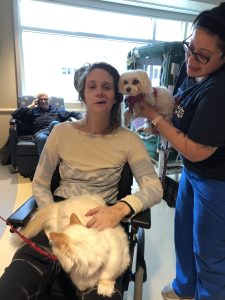
For the next month, Tess made slow progress, while her family rallied around her.
Whitney—a recently retired psychologist with a specialization in neuropsychology and behavioral medicine—was familiar with Craig Hospital. “Some of my former patients had been to Craig,” he explains. “And many of my colleagues strongly urged us to get Tess to Craig as soon as possible.”
So, Whitney traveled to Colorado to tour the hospital: “I knew immediately that everybody was right. Craig was the best place for Tess.”
Because she was medically unstable, Tess needed to get stronger before she could begin her neurorehabilitation at Craig. In the meantime, she moved to a long-term acute care facility that Whitney referred to as “very unsatisfactory.”
When Tess was finally ready, she transferred to Craig. “We sighed in relief as soon as we walked through those doors,” Kate says. “In fact, almost immediately, she was removed from the vent. And for the next five months, Tess received amazing care and support.”
A Father’s Perspective
As a neuropsychologist, Whitney says he had a different view of his daughter’s situation than a “typical” father.
“Initially, I was in shock and could not believe what happened to Tess,” he says. “But I also had a realistic view of the outcome. Due to my professional experience, I knew she would have significant long-term impairments and would never be back to where she was before the accident.”
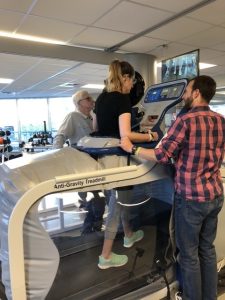
Whitney adds, “Thankfully, I was not in a maze of confusion. I could recognize Craig’s excellence and witnessed the highly specialized, compassionate care Tess was receiving each day. It made me feel extremely comfortable in an extremely uncomfortable situation.”
The Sunderland family strongly believes that Tess’s recovery was possible due to Craig’s unique and exceptional interdisciplinary team.
“From Tess’s doctors and nurses to her therapists and health care professionals, the entire team worked tirelessly to maximize Tess’s physical, cognitive, emotional and behavioral functioning,” Kate says. “The hospital’s goal of helping patients return home as independent and prepared for the future as possible is exactly what Tess needed.”
Back to Craig
In 2019, almost ten years after Tess’s accident in Chaco Canyon, she was back in Santa Fe.
“Tess was doing great,” Whitney says. “She had moved to Santa Fe with us and was living on her own with a friend. And while her coordination and balance had never fully returned, she was able to work part time as a lab technician at her former archeological company. She even resumed her passion of horseback riding.”
But then catastrophe struck again in early 2019 when Tess sustained a hemorrhagic stroke.
“Due to our past experience, we knew exactly what to do and where to go,” Kate says. “We had complete confidence that Craig could help Tess yet again, so we headed back to Colorado.”
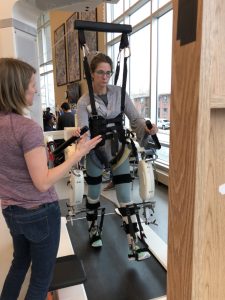
Tess’s second time at Craig proved to be easier than her first. Because the stroke affected a smaller area of her brain, she spent the next three months improving quickly. “Thanks to her understanding of therapy protocols, Tess knew how to navigate her recovery and knew what to expect,” Kate says.
When she returned home to Santa Fe, Tess was unable to go back to work, which was difficult for her. And then COVID-19 hit, causing her to fall into a deep depression. “When the world shut down, Tess felt extremely isolated and distraught,” Whitney explains. “It was a challenging time, but Tess persevered with a lot of love and support.”
Today, she lives at an Omaha-based rehabilitation center specializing in neurological injuries. “Tess has her own apartment on campus and receives support about 30 hours a week,” Kate says. “And she is able to get around campus independently on an electric scooter and is back to riding horses. Tess is happy, which is all we can ask for, especially when your child’s life collapses not once, but twice.”
Life Beyond Brain Injury
For Kate and Whitney, giving back to Craig has become a priority.
Whitney joined the Craig Hospital Foundation Board, and the couple are loyal supporters. Additionally, both Kate and Whitney served on the leadership committee for the Hope & Homecomings Campaign, the hospital’s largest fundraising effort in its 118-year history. The campaign ensures more patients and families have access to Craig’s neurorehabilitation program, expanded healing spaces, and life-changing therapies.
“We feel very strongly about Craig’s new neuromedical unit because there is definitely a need to serve medically complex patients sooner,” Whitney explains. “When it comes to brain injury recovery, having continuity of care without gaps is critical to recovery. Brain injury recovery is complicated, and getting patients to rehabilitation quickly can significantly improve outcomes. Without question, the neuromedical unit will help improve long-term recovery for future brain injury patients.”
Kate adds, “Looking back on Tess’s recovery, we are forever grateful to Craig for their skills, dedication and humanity during an unimaginably difficult time. Watching the hospital team in action makes you want to be involved. We are committed to supporting the hospital because Craig clearly does the work of angels.”
To learn more or donate to help Craig grads like Tess, please visit craighospital.org/foundation/donate.
Keep reading
September 22, 2026
A Legacy of Giving: Steve Baker’s Positive Impact on Craig Hospital
September 8, 2026
A Long Ride Back: Grit, Gratitude and Craig Hospital
August 28, 2026
Miles and Milestones: Ben Edwards Navigates His College Journey