July 3, 2024
On the Road Again: Ashley Weber Finds Independence
“For 20 years, I depended on others to drive me around,” 39-year-old Ashley Weber says. “But finally, I can drive myself and my 14-year-old son, Collin. While Collin never thought I’d be able to do it, he didn’t realize just how motivated I was to get behind the wheel again.”
She adds, “I couldn’t do it without support from Craig’s Driving and Adaptive Transportation Program. They have given me so much freedom and independence—and truly expanded my world.”
An Unimaginable Detour
Back in December 2002, Ashley has just finished her first semester of her second year at Morgan Community College and was working part time at Fort Morgan Hospital, close to her home in rural Wiggins, Colorado.
“I was 18 years old at the time and had just completed high school in May. I planned to graduate with my Associates of Science degree the following year,” she says. “I felt like I was ahead in the game of life. As far as education and experience, I was on the road to fulfilling my dream of pursuing a career in the medical field.”
But a drunk driver altered Ashley’s plans when she was seriously injured in a rollover car accident.
“I broke C1, C4, C5, and exploded C6,” Ashley recalls. “After a 10-hour surgery, I was left with plates and screws from C3 to T1, as well as a new C6 vertebra taken from my left hip bone.”
After two weeks in the ICU, Ashley transferred to Craig Hospital, where she lived for the next six months during her spinal cord injury neurorehabilitation. “I considered Craig my home because everyone was so welcoming and supportive. Dealing with a life-changing event is extremely difficult, but I got through it because of my amazing team at Craig.”
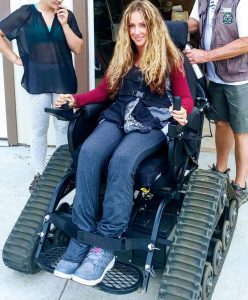
In addition to having to relearn most daily tasks, Ashley endured numerous medical issues, including a very painful spinal cord fluid leak, blood poisoning caused by calcium seeping from her bones, and gallbladder and appendix removals.
Living Life
Despite the difficult challenges Ashley faced, she persevered and refused to let her situation stop her from living an independent life. After leaving Craig, she moved to Longmont, Colorado, to live with her aunt and find work.
But driving was one major obstacle that Ashley was unable to conquer—until she entered Craig’s donor-supported Driving and Adaptive Transportation Program in the fall of 2021. “I was eager to drive and work again because I was tired of depending on others,” she says. “As a single mom to a teenage son, I just wanted to be independent and take care of him without the help of others.”
Barry Doyle, adaptive transportation supervisor at Craig, explains, “Individuals need to be able to access their community. Driving again means re-engaging with all aspects of life, which helps one’s recovery and significantly improves their outlook on life.”
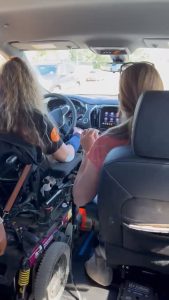
Ashley returned to Craig for several weeks, relearning all aspects of driving and vigorously working on her adaptive driving skills. She learned how to maneuver a car using her limited mobility, as well as navigating emergency situations and working on the cognition required to drive.
“I was so motivated to drive again, but it was challenging because I struggled to feel the road,” Ashley recalls. “The Craig team was great when it came to creating an individualized program for me and figuring out my strengths. I was nervous about highway driving, but the team helped me every step of the way and taught me how to drive directly from my power wheelchair with the gas and brake on my left side.”
Barry adds, “We helped Ashley learn to use a Joysteer® high-tech driving system with a gas/brake tilter to function like a lever and a mini-wheel for steering.”
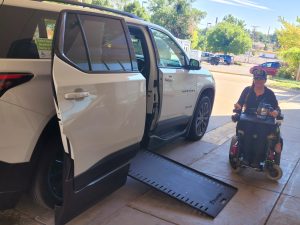
After Ashley completed the driving program, she passed her driving test and purchased a wheelchair accessible vehicle, with the help of the Colorado Division of Vocational Rehabilitation.
Achieving Goals
Today, Ashley, a medical cannabis patient and activist, works as the executive director of Colorado NORML, an organization dedicated to reforming marijuana laws and protecting marijuana patients and consumers.
In addition, she serves on the Board of Governor’s Office of Information Technologies Empathy Committee and works at Heinie’s Market in Wheat Ridge, Colorado, opened by her grandparents back in 1960. “I love being at the market,” she says. “It is great to be able to work in my community.”
Since her accident more than 20 years ago, Ashley has learned a great deal about accomplishing goals and urges others in her situation to surround themselves with supportive people and to set new goals every year.
“Work hard to achieve these goals,” she says. “Driving again was one of my goals, and I worked very hard to achieve it. It’s a huge privilege to be able to drive again, and I am forever grateful for everything Craig has done for me and my son.”
Keep reading
October 7, 2026
A Second Chance at Life
September 22, 2026
A Legacy of Giving: Steve Baker’s Positive Impact on Craig Hospital
September 8, 2026
A Long Ride Back: Grit, Gratitude and Craig Hospital