March 20, 2025
Life After Brain Injury: Returning to Passions and Regaining Independence
On April 4, 2023, Stephanie Porter-Scheinman’s life changed dramatically when she sustained a hemorrhagic stroke that severely damaged her left temporal lobe. “I should have died when this thing, you know, like, it was all here,” Stephanie recalls, gesturing to her head. “There was a question if I could die either or not.”
Stephanie–a retired microbiologist, skilled mountaineer and telemark skier–first spent a couple of weeks recovering at an intensive care unit in Utah before she was admitted to Craig Hospital to begin her neurorehabilitation 20 days after her stroke. When she arrived, she could not walk, and her communication abilities were severely limited. “People are talk to you and eventually, you know, you could, but I was still sick.” she recalls. Stephanie’s husband, Robert, adds that initially she advanced with her physical therapy far more than her speech. “Speech came later,” Robert says. “Yeah, I think that’s right. So, it takes a long time,” Stephanie adds.
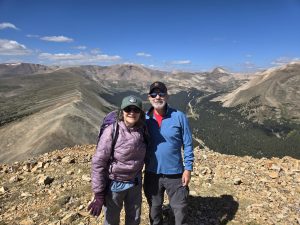 By June 2023, Stephanie had made enough progress to transition out of inpatient care, and in November 2023, she returned for Craig’s outpatient program where she worked on physical therapy, occupational therapy, and speech and language therapy. Though she had regained mobility, her stroke left her with aphasia—a language disorder that impacts a person’s ability to access, use and understand language. While she has difficulty with language processing, her cognitive abilities remain intact.
Determined to continue improving, Stephanie enrolled in the Craig Hospital Aphasia Therapy (CHAT) program in October 2024. CHAT is an intensive outpatient therapy for individuals with aphasia as a result of traumatic or other acquired brain injury. Through in-person or telehealth options, this evidence-based, patient-centered program utilizes one-to-one and group therapy, family training, neurologic music therapy, augmentative and alternative communication, and yoga to improve the quality of life of persons living with aphasia.
“Steph made incredible gains during her CHAT program,” says CHAT Program Coordinator Katie Cassady, MA CCC-SLP, CBIS, C-IAYT. “Her goals in CHAT were to become more consistently able to say high-value words [words she would have a lot of opportunities to say in everyday life] in the moment without cues from her partner. By the end of the program, she was much better able to recognize when words had come out wrong, in addition to being able to come up with those high-value words in the moment.”
After her stroke, Stephanie only had about seven words in her vocabulary, but over time, she has expanded her vocabulary to nearly 80 words. She has also adapted by using assistive technology and alternative communication strategies, such as showing pictures or using gestures to express her thoughts. Robert has learned to navigate her evolving speech. “When she looks outside and it’s blizzarding and says, ‘Wow, it’s hot out,’ I know she means it’s cold,” he explains. “A lot of it is contextual.”
Beyond speech therapy, Stephanie remains committed to regaining her independence. One of her major accomplishments happened recently when she passed a driving evaluation with nearly perfect scores. During her driving test, Stephanie was able to respond correctly to anything on the road, including other drivers and pedestrians, and follow directions from her driving instructor, “He didn’t talk anything, but we went somewhere, and he’d say, ‘Okay, go to the right,’ and I knew to go like in that whenever I was going, I did everything right,” Stephanie says.
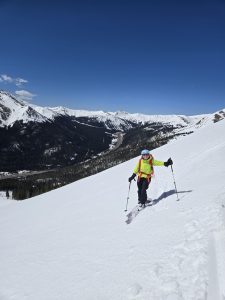
Stephanie has also returned to the adventurous activities that have always brought her joy, such as telemark skiing. Unlike a traditional alpine binding, a telemark skier’s boots are only attached to the ski via the toe—allowing the boot to flex at the instep and the heel to lift completely off the ski. “You need a lot more strength and a lot more balance,” Robert explains. To help with Stephanie’s body awareness and balance, she is looking to practice yoga, a skill she exercised with Katie while she was in the CHAT program.
Looking ahead, Stephanie’s future looks bright with endless possibilities. She has recently begun volunteering at Craig as part of a CHAT group, a program that meets two days a week with current CHAT patients and grads. “Both Steph and Rob will be valuable resources to our patients learning how to live with aphasia,” Katie says. “Connecting with others with aphasia is an integral part of the CHAT program.”
Stephanie is also looking forward to spending more quality time in the outdoors and expanding her vocabulary even further. With Robert’s support and her determination, Stephanie remains focused on regaining even more independence. Robert is confident that with continued adjustment of Stephanie’s seizure medication and returning to the activities she loves, like telemark instruction, she will reclaim even more of her freedom. “You’re on the cusp of being independent again,” he tells her.
Keep reading
October 7, 2026
A Second Chance at Life
September 22, 2026
A Legacy of Giving: Steve Baker’s Positive Impact on Craig Hospital
September 8, 2026
A Long Ride Back: Grit, Gratitude and Craig Hospital