August 1, 2023
The Healing Power of Animals
It was six years ago when Stephen Sell spent four months at Craig Hospital. Recovering from a gunshot wound, Stephen, age 17, was struggling to see the practical effects of his therapy—until he met Meyer and Sully—two yellow Labrador retrievers that regularly visited patients at Craig as part of the hospital’s donor-funded Animal-Assisted Intervention (AAI) program.
“These dogs really helped my recovery and were the highlight of my time at Craig,” Stephen recalls. “Not only did my therapists integrate the dogs into all of my therapies, but Meyer and Sully helped motivate me to push myself and forced me out of my room and into the Craig community.”
Pets as Therapy
Formerly known as pet therapy, the AAI program at Craig connects animal volunteers and their human handlers with patients to help achieve rehabilitation goals.
“Beyond providing joy, comfort and motivation, the animals are used by therapists to help patients speak, control voice volume, activate a specific body part, improve balance and coordination, practice life skills, and enhance fine motor skills and language,” explains Lori Womeldorff, Craig therapeutic recreation specialist. “The possibilities are endless.”
In fact, there are many documented benefits of AAI, including improved mood and well-being, increased emotional awareness and regulation, decreased stress and anxiety, improved immune system and attention, reduced loneliness and aggression, decreased blood pressure, enhanced self-esteem and communication skills, and increased trust and social interactions.
“Dogs do not care if you are having a bad day,” Lori says. “They don’t care if you can’t pet them because your hands are weak or if you can’t speak to them because you don’t have your voice. They take on all of your feelings and thrive in your presence. It’s the unconditional love that animals provide, which helps them bond with so many patients.”
Developed more than 35 years ago, Craig’s AAI program was initially made up of volunteers who visited with unadopted pets from the Humane Society. The program then hosted a local Newfoundland Club, where several owners brought their Newfoundlands to visit patients.
Today, the AAI program—which is part of Craig’s Therapeutic Recreation Program and Volunteer Program—is made up of about 14 certified therapy dogs that visit the hospital with their volunteer handlers. While the days are focused on incorporating the canines into different therapies, the evenings are for relaxation and comfort, with the dogs curling up and snuggling with patients.
A Man’s Best Friend
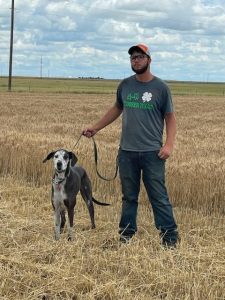
With the help of Meyer and Sully, Stephen was inspired and motivated to support others in a similar situation. After completing his therapy and going home to Booker, Texas, Stephen adopted Belle, a Great Dane, who became his service dog in 2018.
“Belle goes everywhere with me, helping with crowd control, mobility and vision work,” Stephen explains. “I also bring her to nursing homes to visit the residents. Just like Craig’s therapy dogs helped me recover, Belle encourages the residents as well as providing joy and comfort. I feel lucky and blessed to be alive—and it feels really good to be able to help others.”
Keep reading
October 7, 2026
A Second Chance at Life
September 22, 2026
A Legacy of Giving: Steve Baker’s Positive Impact on Craig Hospital
September 8, 2026
A Long Ride Back: Grit, Gratitude and Craig Hospital