December 15, 2023
Full Speed Ahead: Mackenzie Langley Makes Her Dreams a Reality
“It’s very difficult for women to break into the tech startup world,” Mackenzie Langley explains. “And it’s even more difficult when you’re a woman in a wheelchair.”
But the 25-year-old refused to let this stop her when she entered the 2023 CodeLaunch competition in Dallas for new tech entrepreneurs.
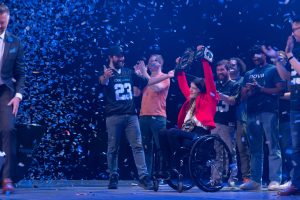 In fact, Mackenzie’s startup, Lighthouse (a social network that makes it easy for nonprofit leaders to develop strategic partnerships and share resources to increase their impact on the communities that they serve) was named the overall startup champion, in addition to winning the Judges’ Choice award on November 15, 2023.
“Winning CodeLaunch was absolutely incredible,” she recalls. “CodeLaunch is a very powerful community that encourages tech founders to succeed. Because of this experience, I am energized to keep moving forward.”
And moving forward has been one of Mackenzie’s main goals since her car accident in the summer of 2014.
A Slow Recovery
On the night of June 23, 2014, Mackenzie, who was 16 years old at the time, was a passenger in a friend’s SUV as they drove along a mountain road near her home in Aspen, Colorado.
When a sharp turn in the road caused the car to skid 35 feet before flipping and skidding an additional 270 feet on the car’s roof, Mackenzie was partially ejected. She sustained numerous injuries, including skull fractures, a broken jaw, vision loss, a partially severed carotid artery, nine spinal fractures, facial paralysis, a severe concussion and hearing loss.
After spending 10 days in a medically induced coma and two additional weeks at Children’s Hospital Colorado, Mackenzie transferred to Craig Hospital.
It was here that Mackenzie slowly began to recover. “There were many lows in my journey—which included complications resulting in four back surgeries, having to use a feeding tube due to my wired jaw, and severe weight loss, as well as learning to navigate a wheelchair and adjusting to my new normal.”
She adds, “But there were also many highs. While I couldn’t step into a classroom for a full year, Laura Magnuson, Craig’s School Program teacher and coordinator, helped me get through my junior year while I was at Craig. I will forever be grateful for her support and motivation.”
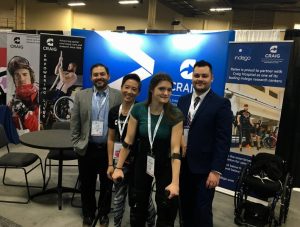
In addition, Mackenzie, one of five children, was far from her home in Aspen. But Craig’s donor-supported Family Housing enabled Mackenzie’s mother, Darnell, to stay close to her daughter. And Craig’s PEAK Center was Mackenzie’s home away from home during her outpatient therapy.
“It was extremely difficult living far from home and feeling so afraid of not being the same person I was before my accident,” she says. “I used to be a soccer and hockey player, and I knew that was no longer possible for me.”
Mackenzie adds, “But Craig helps normalize what you are going through. The entire staff truly cares and gives you the tools to be independent. They work hard to set you up for success. I still remember my dad telling me that nobody at Craig wants to be at Craig, but everyone at Craig is happy to be at Craig. They build a strong community for patients, so you’re not alone. And during that time in your life, you really need the feeling of community.”
Moving On
Thanks to Craig’s School Program, Mackenzie was able to return to Aspen High School for her senior year and graduated on time.
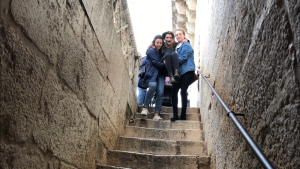
“I attended the University of Denver, with financial assistance from a Craig Alumni Educational Scholarship,” she explains. “DU’s proximity to Craig and the PEAK Center definitely influenced my college choice. While it wasn’t easy learning to live on my own as a freshman, PEAK helped support me and build my confidence. At PEAK, you are seen as a whole person—with no expectations. It’s a breath of fresh air.”
After graduating with a degree in sociology and a minor in writing and entrepreneurship, Mackenzie took a teaching job in Spain. “Some people were surprised that I wanted to take on that type of challenge in a wheelchair, but going abroad was really good for me. I refused to let my chair stop me from following my dreams.”
And developing Lighthouse was yet another dream of Mackenzie’s.
“Lighthouse is a social network for nonprofits,” she says. “The idea came to me after my accident when I couldn’t find niche support services on Google. I realized this was a much-needed service, and in 2021, I began developing this idea into a business.”
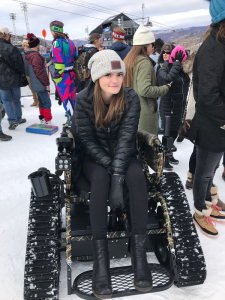
Looking back on the last few years, Mackenzie insists that while adjusting to life after a spinal cord injury was quite challenging, her experiences have made her grow as a person.
“The empathy I have gained through my ordeal has given me a clear vision for my future,” she explains. “I do my best to lead my life with compassion, and I understand that we all face challenges. I have experienced kindness, assistance and support through nonprofits. I am inspired by the amazing work these organizations accomplish, and I want a job that has purpose and meaning. Through my work with Lighthouse, I hope to help lighten the load that people in need must carry.”
Keep reading
October 7, 2026
A Second Chance at Life
September 22, 2026
A Legacy of Giving: Steve Baker’s Positive Impact on Craig Hospital
September 8, 2026
A Long Ride Back: Grit, Gratitude and Craig Hospital