September 15, 2025
Shifting a Perspective of Paralysis to a Vision of What’s Possible
When Logan Fuller arrived at Craig Hospital as a 17-year-old in the summer of 2017 for spinal cord injury neurorehabilitation, he felt lost and hopeless.
“I was a high school wrestler and football player before my car accident and thought that part of my life was over,” Logan recalls. “I just couldn’t see myself enjoying sports in a wheelchair.”
“But when I was introduced to wheelchair rugby at Craig, it ignited something in me that I thought I lost. I found something that not only gave me the opportunity to live an active and healthy life—but gave me a strong sense of community, as well as something to aspire to be good at and something to live for. I became obsessed with being in my rugby chair and working toward being a champion.”
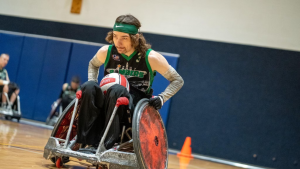
Fast forward to January 2025 when USA Wheelchair Rugby selected Logan for its national training squad.
“After attending a five-day selection camp at Lakeshore Foundation, a U.S. Olympic and Paralympic Training Site in Birmingham, Alabama, I was told that I made the team,” Logan explains. “I was so surprised and excited to hear that I was selected. What an honor! I have worked so hard for this and couldn’t be happier. It’s amazing to think that it was just eight years ago that I was introduced to the sport of rugby at Craig!”
Finding Rugby
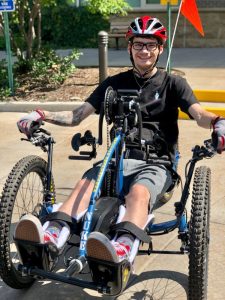
“If patients are interested in being active post-injury, we show them a variety of adaptive sports to see what will be a good fit,” says Danielle Scroggs, a recreational therapist at Craig. “We want patients to understand they can still be athletes—even after an injury. Our number one goal is providing them with a sense of community through sports.”
She adds, “Because wheelchair rugby is such a high-impact, adrenaline-filled sport, I knew it would be perfect for Logan. Shortly after he arrived at Craig, I put him in a rugby wheelchair and together with his father, we all played a game of wheelchair rugby in the gym.”
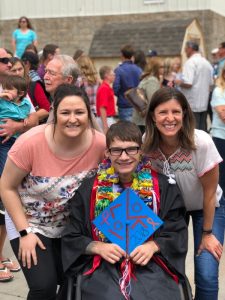
Logan remembers being hooked immediately: “Being able to play rugby shifted my perspective of paralysis to a vision of what’s possible.”
After leaving Craig, Logan went home to Cortez, Colorado, for a year before attending Colorado State University in Fort Collins. It was here that he became very involved in the sport, playing wheelchair rugby every Tuesday night and attending rugby tournaments.
“Danielle introduced me to Nick Pearce, a Craig alum and head coach of the Denver Barbarians Wheelchair Rugby Club. He invited me to play on the club team and helped me become a better player,” Logan explains. “I set my goal on playing in the 2028 Summer Paralympics, which will be held in Los Angeles, and began working toward that goal by training five to six days a week.”
Competition at the Highest Level
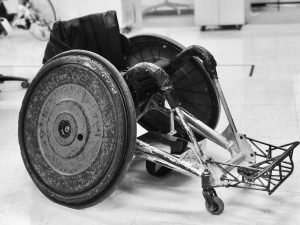
Five years ago, Logan purchased a rugby wheelchair with the help of a collaborative, donor-supported scholarship between the Kelly Brush Foundation (KBF) and Craig Hospital. KBF—a nonprofit organization focused on inspiring and empowering individuals with spinal cord injuries to lead active and engaged lives—partners with the Craig Foundation to help make these dreams come true. But the game of wheelchair rugby is extremely physical, and the chairs take a beating. In fact, the aggressive, full-contact sport often lives up to its nickname of “murderball.”
“Because of this, I really needed a new chair. However, chairs are incredibly expensive,” he explains.
So Logan recently applied for another Craig Hospital/KBF collaborative scholarship and received a grant to help him purchase a new Melrose High Point rugby chair.
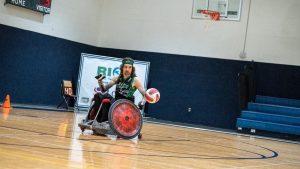
“Receiving this equipment scholarship will change my life in many ways,” he says. “It gives me the opportunity to continue my rugby career not only in the U.S., but internationally as well. I made Team USA for the first time this year, and my chair is old and completely falling apart. If I am going to travel and compete at my best, I need reliable equipment.”
Tyler Hofferberger, equipment manager for the Denver Barbarians Wheelchair Rugby Club, adds, “It’s remarkable that Logan has achieved this level of elite performance, while playing in the same rugby chair for more than five years. It’s a clear testament to his perseverance and adaptability. In a sport where equipment can make a critical difference, Logan never used that as an excuse. Instead, he focused on developing smart, strategic play and unmatched work ethic. Logan is not just a standout athlete, but a true ambassador for wheelchair rugby and the adaptive sports community.”
And Danielle couldn’t agree more: “Logan has so much drive, as well as heart and soul. I am extremely proud of him and all of his hard work. I knew he’d make Team USA, and I am hoping he will be playing in Los Angeles in 2028. If he qualifies, I will definitely be there watching him play!”
To learn more or donate to help Craig patients like Logan, please visit craighospital.org/foundation/help-patients.
Keep reading
October 7, 2026
A Second Chance at Life
September 22, 2026
A Legacy of Giving: Steve Baker’s Positive Impact on Craig Hospital
September 8, 2026
A Long Ride Back: Grit, Gratitude and Craig Hospital