July 24, 2026
Studying How the Environment Impacts Individuals with Spinal Cord Injuries
While on a Hawaiian vacation in the spring of 2018, Rick Urso’s life changed in an instant.
“My family and I were surfing in Maui when a wave threw me onto the ocean floor,” Rick recalls. “With two seconds of breath left in me, my youngest son found me face down in the water. He quickly rolled me over and called for help.”
He adds, “I remember thinking I was hurt, but I had no idea that I sustained a C6 spinal cord injury.”
After spending about two weeks in a Honolulu hospital, Rick and his family flew home to Denver to begin three months of spinal cord injury rehabilitation at Craig.
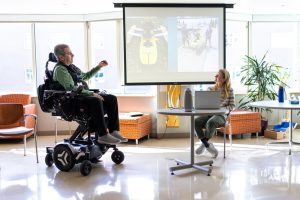
Today, the 64-year-old regularly works out at a local wellness center offering fitness programs for individuals living with paralysis. “I have been working out there since leaving Craig,” he says. “My goal is to increase my strength, so I’m able to do my own transfers and improve my independence.”
While being self-sufficient is very important to Rick, this can be quite challenging, due to the numerous obstacles he must navigate in his community. “Parking and doorways are by far the biggest issues I face on a daily basis,” he explains. “It’s not always easy to be in a wheelchair and get around.”
And it’s this challenge that inspired Rick to participate in a study at Craig, Identifying How the Environment Affects Life with Spinal Cord Injury (SCI) Using Geographically Explicit Momentary Assessment.
“Over the years, I have volunteered to participate in several Craig studies,” he says. “But this one really hits home for me.”
Studying Daily Life
Together with three other collaborating sites, the Research Department at Craig is working to understand the role that the community environment plays in the daily lives of individuals with a spinal cord injury.
Developed under a grant from the National Institute on Disability, Independent Living, and Rehabilitation Research, the study collects and analyzes real-time activity data from the perspective of individuals with SCI as they engage in community activities outside their home.
Individuals participating in the study collect data with a Garmin watch, complete surveys online and via a smartphone app, and participate in interviews with a study team member. Data collection lasts for one week and is repeated a total of three times over a six-month period.
Participants include a total of 80 people living with chronic impairment from traumatic or non-traumatic SCI. In addition to Craig Hospital, enrollment is currently taking place at three other SCI Model System center sites, including Kessler Foundation in New Jersey, Baylor Scott and White Research Institute in Texas, and the University of Alabama at Birmingham.
“Our goal in conducting this research is to learn more about community accessibility around the country,” explains Claire Huston, a research assistant at Craig. “We hope to identify and understand how environmental factors shape community participation and integration outcomes for people with SCI. The information from this study will be used to help make the community more inclusive for people with SCI and other disabilities.”
For Rick, who is very active and constantly on the move, making the community more accessible would be extremely helpful: “We have a long way to go when it comes to making our world accessible and inclusive, but studies like these can help move us in the right direction.”
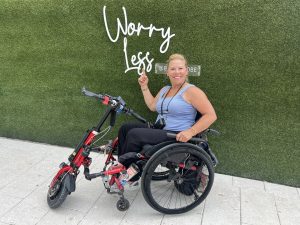
Improving accessibility is also extremely important to Chris Layne, another study participant, Craig grad and disability advocate.
“In October 2016, I was celebrating my son’s birthday with a hiking adventure when I lost my footing and fell 80 feet into Clear Creek Canyon,” she recalls. “The fall shattered my T6-7 vertebrae, leaving me paralyzed from the chest down.”
Chris spent two months at Craig, rebuilding her strength, confidence and independence. “After returning home, I left my nursing job and became a disability advocate and public speaker,” she says. “I won Ms. Wheelchair Colorado in 2020 and 2021—a program focused on educating the public, advocating for people with disabilities, and empowering women in wheelchairs to live their best lives.”
As a study participant, Chris hopes that Craig’s research will help make positive changes. “Wheelchair users encounter challenges and obstacles every day,” she says. “Hopefully, this study will highlight the many barriers we face and raise awareness. We need to make our community more accessible and inclusive for everyone.”
For more information on this study, please visit: https://craighospital.org/research/studies
For more information on supporting research at Craig Hospital, please visit: https://craighospital.org/foundation/donate
Keep reading
October 7, 2026
A Second Chance at Life
September 22, 2026
A Legacy of Giving: Steve Baker’s Positive Impact on Craig Hospital
September 8, 2026
A Long Ride Back: Grit, Gratitude and Craig Hospital